People still look around on here. (Bless your little hearts.) I should let folks know that one reason I have been so quiet is that I've moved AND gotten married this summer. (Which takes it out of you I can tell you...)
Things may start to quiet down soon...and then I might just start spouting off again. (Alert the media...)
Monday, July 31, 2006


Friday, May 12, 2006
NEW REVELATIONS!!!!!!!!!!!!!!!
BREAKING NEWS!!!!!!!!!!!!!!!!!!!
It turns out the government's ability to look at your phone records without a court order has only been a settled point of law since 1979! (see Smith v. Maryland) In an opinion written by conservative firebrand Harry "Hang 'em High" Blackmun and joined by such dangerous reactionaries as Warren "Shoot First" Burger & John "Rights Schmights" Stevens, the court held:
(a) Application of the Fourth Amendment depends on whether the person invoking its protection can claim a "legitimate expectation of privacy" that has been invaded by government action. This inquiry normally embraces two questions: first, whether the individual has exhibited an actual (subjective) expectation of privacy; and second, whether his expectation is one that society is prepared to recognize as "reasonable."
(b) Petitioner in all probability entertained no actual expectation of privacy in the phone numbers he dialed, and even if he did, his expectation was not "legitimate." First, it is doubtful that telephone users in general have any expectation of privacy regarding the numbers they dial, since they typically know that they must convey phone numbers to the telephone company and that the company has facilities for recording this information and does in fact record it for various legitimate business purposes. And petitioner did not demonstrate an expectation of privacy merely by using his home phone rather than some other phone, since his conduct, although perhaps calculated to keep the contents of his conversation private, was not calculated to preserve the privacy of the number he dialed. Second, even if petitioner did harbor some subjective expectation of privacy, this expectation was not one that society is prepared to recognize as "reasonable." When petitioner voluntarily conveyed numerical information to the phone company and "exposed" that information to its equipment in the normal course of business, he assumed the risk that the company would reveal the information to the police.
It goes without saying that it would be unreasonable to expect reporters or lawmakers to be "up on" a legal precedent that has only been on the books for 27 years.
It turns out the government's ability to look at your phone records without a court order has only been a settled point of law since 1979! (see Smith v. Maryland) In an opinion written by conservative firebrand Harry "Hang 'em High" Blackmun and joined by such dangerous reactionaries as Warren "Shoot First" Burger & John "Rights Schmights" Stevens, the court held:
(a) Application of the Fourth Amendment depends on whether the person invoking its protection can claim a "legitimate expectation of privacy" that has been invaded by government action. This inquiry normally embraces two questions: first, whether the individual has exhibited an actual (subjective) expectation of privacy; and second, whether his expectation is one that society is prepared to recognize as "reasonable."
(b) Petitioner in all probability entertained no actual expectation of privacy in the phone numbers he dialed, and even if he did, his expectation was not "legitimate." First, it is doubtful that telephone users in general have any expectation of privacy regarding the numbers they dial, since they typically know that they must convey phone numbers to the telephone company and that the company has facilities for recording this information and does in fact record it for various legitimate business purposes. And petitioner did not demonstrate an expectation of privacy merely by using his home phone rather than some other phone, since his conduct, although perhaps calculated to keep the contents of his conversation private, was not calculated to preserve the privacy of the number he dialed. Second, even if petitioner did harbor some subjective expectation of privacy, this expectation was not one that society is prepared to recognize as "reasonable." When petitioner voluntarily conveyed numerical information to the phone company and "exposed" that information to its equipment in the normal course of business, he assumed the risk that the company would reveal the information to the police.
It goes without saying that it would be unreasonable to expect reporters or lawmakers to be "up on" a legal precedent that has only been on the books for 27 years.
Thursday, May 11, 2006
Non-Story Of The Week
Try as I might I can see no reason to take the latest NSA story seriously. When the previous stories arose about the "warrentless eavesdropping" I could at least see two sides to the issue. I just didn't think it was all that important. Look, when one side advocates doing thing "X" and the other side pushes "Y" I really want "Y" to be something more than "X with extra paperwork." At least if you want me to think it is something vitally important.
In this case however I can't see another side that isn't downright stupid. Nobody's conversations are being listened to. Nobody's "privacy rights" are being infringed, because you don't have any privacy when it comes to what phone number you call or call you. Agents of the government (police and district attorneys for example) look at this type of information every day without the need for warrants, or probable cause, or even your permission. (Don't members of Congress ever watch "Law & Order"?) I can't even think of a way in which this type of data mining activity could be abused. Can anyone else?
Unfortunately, this is the sort of crap you have to deal with every election year. December can't come soon enough.
In this case however I can't see another side that isn't downright stupid. Nobody's conversations are being listened to. Nobody's "privacy rights" are being infringed, because you don't have any privacy when it comes to what phone number you call or call you. Agents of the government (police and district attorneys for example) look at this type of information every day without the need for warrants, or probable cause, or even your permission. (Don't members of Congress ever watch "Law & Order"?) I can't even think of a way in which this type of data mining activity could be abused. Can anyone else?
Unfortunately, this is the sort of crap you have to deal with every election year. December can't come soon enough.
Sunday, April 30, 2006
Do Old Blogs Just Fade Away?
It amazes me to see so many people check out this blog on a semi-regular basis, or that so many stumble across it by accident. Lord knows it hasn't been a going concern for quite some time. For any of those who really enjoyed my writing, I'm sorry about that.
The main trouble I have with blogging in general is that after awhile you feel like you are having the same arguments over and over. It can get a little tedious. I suppose this is why newspaper columnists can become so mind numbingly boring.
Oh, dont get me wrong. I can still get worked up over things...I just can't get that worked up about writing about them. I will keep the blog alive until the day comes and I do get fired up about my writing. That could happen next week or even tomorrow.
Anybody want to place a bet on when I come back full time?
The main trouble I have with blogging in general is that after awhile you feel like you are having the same arguments over and over. It can get a little tedious. I suppose this is why newspaper columnists can become so mind numbingly boring.
Oh, dont get me wrong. I can still get worked up over things...I just can't get that worked up about writing about them. I will keep the blog alive until the day comes and I do get fired up about my writing. That could happen next week or even tomorrow.
Anybody want to place a bet on when I come back full time?
Tuesday, February 21, 2006
Sharia Harvard Style?
From the BBC: Beleaguered Harvard head to quit
There are those in some departments of American collegiate Arts & Sciences that seem to know as little of free speech as any anti-Danish rampaging horde.
The president of Harvard University has announced his resignation after a turbulent five years and a week ahead of a second no-confidence vote.
Lawrence Summers lost the first vote in March last year after suggesting women had less "intrinsic aptitude" than men for science.
The ex-Treasury secretary, whose tenure is the briefest in 140 years, will leave at the end of this academic year.
He said the rift with some staff made his agenda of renewal "infeasible".
Dr Summers' controversial leadership style has divided opinion at the Ivy League university.
His comments on gender, for which he repeatedly apologised, led the Faculty of Arts and Sciences to pass the no-confidence vote last March.
There are those in some departments of American collegiate Arts & Sciences that seem to know as little of free speech as any anti-Danish rampaging horde.
Sunday, February 05, 2006
Happenstances
I am finding it very odd that the whole Danish cartoon business is coming to a head at the exact moment I happen to be reading Laurence Lampert's "Nietzsche & Leo Strauss." What is the connection? Well, a prominent theme in the book is Strauss' contention that if you, as a philosopher, want to espouse something which would be viewed as impious by the orthodoxy of the day, you shouldn't come right out and say it. It is better, claims Strauss, to speak and write esoterically in such a way that you will be understood only by a few who might be open to what you have to say. This approach allows the philosopher to avoid the fate of Socrates, who was impolitic in his pursuit of truth, ran afoul of the ruling orthodoxy, and paid for it with his life. Eventually, teaches Strauss, the philosopher (or maybe a successive generation of students of the philosopher) can gradually change the orthodoxy to allow a safe space for philosophy to exist and prosper.
It is most ironic that Strauss claims to have learned this "method" largely from the work of the Islamic philosopher Al Farabi. It is ironic because Al Farabi's attempt to alter the orthodoxy of Islam in ANY way conducive for philosophy can only be viewed as a utter failure. Islamic orthodoxy seems to be as medieval as it ever has been. Indeed, there doesn't seem to be a level of barbarism the orthodoxy can descend to that the greatest mass of Muslims won't embrace or acquiesce to. As an historical "movement," there can be fewer things LESS effectual than the ideas of Al Farabi in the Islamic world. With this as a backdrop Strauss' adoption of the "technique" seems more an act of desperation than anything else.
Also, it isn't as if open defiance of ruling orthodoxies hasn't worked. Algernon Sidney may have lost his head, but it was his ideas that eventually won the day, not Filmer's. Locke may have had to flee the country during his lifetime, but we still read him 300+ years later. Who reads Hooker but a specialist?
We have already fought our battles so we don't have to live with the dehumanizing orthodoxies Islamic societies wish to impose in their own countries. That strikes me as something we would want to shout from the rooftops not whisper in the shadows. If we start whispering about the right of free human expression the shadows will do nothing but increase.
It is most ironic that Strauss claims to have learned this "method" largely from the work of the Islamic philosopher Al Farabi. It is ironic because Al Farabi's attempt to alter the orthodoxy of Islam in ANY way conducive for philosophy can only be viewed as a utter failure. Islamic orthodoxy seems to be as medieval as it ever has been. Indeed, there doesn't seem to be a level of barbarism the orthodoxy can descend to that the greatest mass of Muslims won't embrace or acquiesce to. As an historical "movement," there can be fewer things LESS effectual than the ideas of Al Farabi in the Islamic world. With this as a backdrop Strauss' adoption of the "technique" seems more an act of desperation than anything else.
Also, it isn't as if open defiance of ruling orthodoxies hasn't worked. Algernon Sidney may have lost his head, but it was his ideas that eventually won the day, not Filmer's. Locke may have had to flee the country during his lifetime, but we still read him 300+ years later. Who reads Hooker but a specialist?
We have already fought our battles so we don't have to live with the dehumanizing orthodoxies Islamic societies wish to impose in their own countries. That strikes me as something we would want to shout from the rooftops not whisper in the shadows. If we start whispering about the right of free human expression the shadows will do nothing but increase.
Thursday, February 02, 2006
Kill Two Birds With One Stone
Support Denmark: Buy and drink Danish beer. LOTS of it.
Either you are for free speech or you ain't. Muslims who really want to live in free societies are gonna have to learn how to cope. There isn't any other alternative.


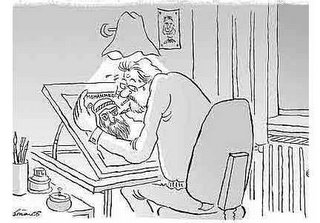


Big time kudos to Michelle Malkin for pushing this hard.
Either you are for free speech or you ain't. Muslims who really want to live in free societies are gonna have to learn how to cope. There isn't any other alternative.
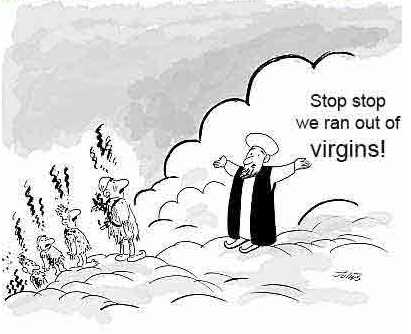

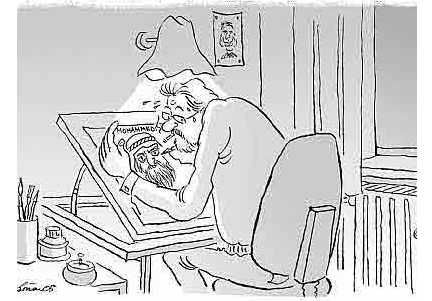

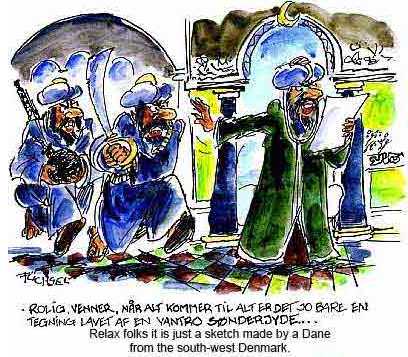
Big time kudos to Michelle Malkin for pushing this hard.
Thursday, January 19, 2006

Wednesday, October 12, 2005
Worse Than Denkinger
This is saying a lot coming from the kind of Cards fan I am, but the call in the 9th inning of tonights Angels/White Sox game is the worst I have ever seen in a Major League Baseball game. It was as if the umps were bound and determined to see the White Sox win. It was completely baffling and totally inexcusable. I blame not only the Home Plate umpire for making the bonehead call in the first place, but I also blame every other ump on the field for being more interested in covering the ass of the Home Plate ump than they were in getting the call right.
The Angels mean nothing to me, I dislike American League baseball as a matter of course, but I can see when someone was robbed. The Angels were robbed.
It is enough to make one wonder if anyone is keeping track of the umpires bank accounts. Maybe they ought to be.
The Angels mean nothing to me, I dislike American League baseball as a matter of course, but I can see when someone was robbed. The Angels were robbed.
It is enough to make one wonder if anyone is keeping track of the umpires bank accounts. Maybe they ought to be.
Thursday, October 06, 2005
First Step: Admitting It
Alright, alright....I have a problem. I'm suffering from something that might be called "Competition Stress Disorder." It is all the St. Louis Cardinals fault. The thing is, when they get themselves into the post-season I go nuts. On game days I get very extremely gut-wrenchingly nervous, which makes it difficult to read, write, talk, eat, sleep, breathe, etc. If they win that day's game I get a short respite, from the time the game ends until the time I wake up on the next game day. If they lose that day's game I simply remain in a state of high anxiety and misery until they win again.
When you think about it, it is all rather miserable. If you have ever seen the movie Fever Pitch you can get a good idea of what I'm talking about. (I'm talking about the proper English version here, and not the truly horrific and abysmal Americanized one.) There can be moments of unreserved joy, but the vast majority of the time you are faced with uncertainty, anxiety, anger, heartbreak and misery. Sounds like fun, right?
Part of me would really like to jump off of this rollercoaster, but I know I never will. It would be nice to avoid the depressions that descend upon me whenever the season ends in failure (as it has in every baseball season of my life except one.) But the truth is I'm hooked. The depressions are really of a minor variety, and they are easily dispelled after a few weeks by the knowledge that Spring Training is only a winter away, and the promise of victory is just too sweet to pass up.
Such are my thoughts at Noon on game day.
Maybe I should go out and get some Rolaids.
When you think about it, it is all rather miserable. If you have ever seen the movie Fever Pitch you can get a good idea of what I'm talking about. (I'm talking about the proper English version here, and not the truly horrific and abysmal Americanized one.) There can be moments of unreserved joy, but the vast majority of the time you are faced with uncertainty, anxiety, anger, heartbreak and misery. Sounds like fun, right?
Part of me would really like to jump off of this rollercoaster, but I know I never will. It would be nice to avoid the depressions that descend upon me whenever the season ends in failure (as it has in every baseball season of my life except one.) But the truth is I'm hooked. The depressions are really of a minor variety, and they are easily dispelled after a few weeks by the knowledge that Spring Training is only a winter away, and the promise of victory is just too sweet to pass up.
Such are my thoughts at Noon on game day.
Maybe I should go out and get some Rolaids.
Sunday, October 02, 2005
The No-Brainer Of All No-Brainers
You can consider this "home cooking" if you want, but I think Bernie Miklasz of the St. Louis Post-Dispatch has the National League MVP "race" nailed. It's Albert Pujols in a land-slide.
Of course Pujols lacks that one thing needed for true baseball greatness: An East coast or West coast address.
Pujols was honored Saturday as the first baseman on the all-time Busch Stadium team. With this final-weekend blast of offense, Pujols seems determined to strike the first wrecking-ball blow to the old ballpark.
Perhaps this late explosion will be noticed by the MVP voters, who must submit their ballots by late Sunday. Remarkably, Pujols may be denied the MVP again if voters transfix on Atlanta's Andruw Jones and his 51 homers and league-leading RBI total while ignoring his mediocre overall batting average (.262) and his comically inferior .207 average with runners in scoring position.
If Jones receives the MVP, it'll be with the lowest batting average in the history of the award. And Jones' batting average with runners in scoring position ranks 64th in the National League.
"Albert is the MVP, and with no disrespect to Andruw Jones, it's by a healthy margin," Cardinals manager Tony La Russa said. "Just put together everything he does: the hitting, the leadership, the defense, the way he runs the bases. The whole game."
Of course Pujols lacks that one thing needed for true baseball greatness: An East coast or West coast address.
Thursday, September 29, 2005
Fashion Fascists
Thinking of painting that spare bedroom? Well you might want to first run your color scheme by the self appointed Gestapo of Interior Design, Jill Gaulding and Erin Buzuvis to make sure you don't run afoul of any politically correct standards.
I'll admit, it's a silly little story, but it does prove a point: There is no aspect of your life that these people do not want to control. The entire world must be changed to suit their sensibilities and their sensibilities alone. These are the same people who complain all the time about religious folks trying to "impose their beliefs on the rest of us." That's fine. Just look in the mirror the next time you utter that phrase. It applies equally well, sister.
The pink visitors' locker room at the University of Iowa's stadium is making some people see red.
Several professors and students joined the call Tuesday for the athletic department to do away with the pink showers, carpeting and lockers, a decades-long Hawkeye football tradition.
Critics say the use of pink demeans women, perpetuates offensive stereotypes about women and homosexuality, and puts the university in the uncomfortable position of tacitly supporting those messages.
"I want the locker room gone," law school professor Jill Gaulding told a university committee studying the athletic department's compliance with NCAA standards, including gender equity.
For decades, visiting football teams playing at Kinnick Stadium have dressed and showered in the pink locker room. The tradition was started by former Iowa coach Hayden Fry, a psychology major who said pink had a calming and passive effect on people.
I'll admit, it's a silly little story, but it does prove a point: There is no aspect of your life that these people do not want to control. The entire world must be changed to suit their sensibilities and their sensibilities alone. These are the same people who complain all the time about religious folks trying to "impose their beliefs on the rest of us." That's fine. Just look in the mirror the next time you utter that phrase. It applies equally well, sister.
Tomorrow Never Knows
For those wondering, yes, I'm still gonna go on about that Time piece on "hurricanes and global warming." I think, if you read the article closely, you can see a harbinger of the future path of the debate. The article abruptly changes focus near the end to tell us all the following:
Movie fans will recognize this immediately as the Day After Tomorrow scenario, a big hit with the "Coast-to-Coast AM" crowd. Those with some background in game theory will also recognize something else. There seems to be a shift away from the view of climate change as an incremental process and towards a view of climate change as a movement towards an unknowable catastophic tipping point; in game theory parlance what is known as "The Tragedy of the Commons." (TOTC)
The classic version of this multi-iterated game postulates a village common upon which the villagers can choose to either add a cow or not. The villager that adds a cow to the common will recieve a benefit, while those that do not will gain nothing. However, there is a catch. The common can only support so many cows, after which the ecosystem collapses and ALL the cows die and every villager loses big time. Another aspect to the game is that tipping point is unknown and unknowable to the villagers. In the classic two-player version of the TOTC there are two payout structures, one pre-tipping point, the other post-tipping point. Because of the two payout structure of the game, in most instances it is more worthwhile to keep adding cows, thus the poor dumb villagers push there luck further and further until the ultimate collapse happens and they all die of starvation. Serves them right.
Now, there are many problems that arise when you try to view real life situations as a version of TOTC. The most basic problem, with regards to this discussion, is the very artificial rule that requires the tipping point to be unknowable. This has to remain, or the psychological impulse that drives people to the ultimate collapse will be absent. However, it is difficult to find a real world example of this type of situation. There have been attempts to view, for example, fishing areas as examples of TOTC, but these do not work so well. In all of those cases fishermen can see a diminishing return and catch that will clue them in when an area is being overfished. Thus the impulse to add another boat to the fishing fleet can be tempered by the fact that you wont break even if yeilds fall too greatly. In any event, whatever is being played out it is not TOTC.
However, that doesn't keep folks from trying to maintain that this or that situation in the real world is really a TOTC scenario in the making. And such it will be with global warming. The people who want to impose drastic changes to our economic system and way of life in the name of global warming have come across a problem or two in pushing the incremental global warming model. One of the most pressing comes from the likes of Bjorn Lomborg, who compltely accepts global warming AND the human causation of the same, but who argues against the changes to our economic system and way of life. Instead, Lomborg argues that we should be supporting our economic system as being the best possible model to maintain the wealth needed to combat any problems arising from a warmer climate. This kind of argument drives the global warming crowd batty. Based on the piles of derision heaped upon Lomborg one would have thought he was a global warming dissenter, but he isn't. He just differs from them on what he thinks the proper political solution is to the problem. If you come across any of the anti-Lomborg material don't make the mistake of thinking it has anything to do with science, because it doesn't.
If the global warming crowd can get folks to accept that this is really a TOTC situation and NOT incremental change they can avoid all of these types of difficulties. For starters, they wouldn't be required to prove that a TOTC model correct. The tipping point is unknowable by definition. If anyone asks them how they know we are nearing the tipping point and what that point is exactly, they can throw up their hands and say, "But that is impossible! You are asking the impossible of me!" And thus endeth the debate.
Which brings up another, more sinister aspect, of making of global warming a TOTC. If you get enough people to go along with the idea it truly is a path to dictatorial power. The psychological implications of the game are profoundly anti-democratic. In order to keep the tipping point from being crossed you would have to give power to someone (going back to the village common) who will keep people from adding cows, or in this society tell us who may or may not have an automobile or who might engage in any activity that is deemed potentially harmful. And by the logic of the game that would be correct. It would spit in the face of the Constitution, but it isn't as if that hasn't happened before.
Before I give off I want to direct folks to this link from the blog DADvocate. He comes up with the following analysis on the history of hurricane intensity. It is very well done. His findings are summarized below:
Year Avg. WS Min Avg WS Max
1851-1860 92.53 111.32
1861-1870 85.27 103.33
1871-1880 93.55 111.75
1881-1890 92.32 110.23
1891-1900 96.19 115.48
1901-1910 87.11 106.11
1911-1920 93.38 113.10
1921-1930 96.38 115.77
1931-1940 101.11 118.95
1941-1950 95.75 114.38
1951-1960 96.24 116.76
1961-1970 102.36 120.36
1971-1980 90.00 109.17
1981-1990 89.13 109.33
1991-2000 99.86 117.14
2001-2004 93.44 112.78
If you can find "dramatic increases in intensity" in there you really must be good with the old divining rod.
Some scientists are studying not just climate change but the even more alarming phenomenon of abrupt climate change. Complex systems like the atmosphere are known to move from one steady state to another with only very brief transitions in between. (Think of water, which when put over a flame becomes hotter and hotter until suddenly it turns into steam.) Ice cores taken from Greenland in the 1990s by geoscientist Richard Alley of Pennsylvania State University show that the last ice age came to an end not in the slow creep of geological time but in the quick pop of real time, with the entire planet abruptly warming in just three years.
"There are thresholds one crosses, and change runs a lot faster," Alley says. "Most of the time, climate responds as if it's being controlled by a dial, but occasionally it acts as if it's controlled by a switch." Adds Laurence Smith, an associate professor of geography at UCLA who has been studying fast climate change in the Arctic: "We face the possibility of abrupt changes that are economically and socially frightening."
Movie fans will recognize this immediately as the Day After Tomorrow scenario, a big hit with the "Coast-to-Coast AM" crowd. Those with some background in game theory will also recognize something else. There seems to be a shift away from the view of climate change as an incremental process and towards a view of climate change as a movement towards an unknowable catastophic tipping point; in game theory parlance what is known as "The Tragedy of the Commons." (TOTC)
The classic version of this multi-iterated game postulates a village common upon which the villagers can choose to either add a cow or not. The villager that adds a cow to the common will recieve a benefit, while those that do not will gain nothing. However, there is a catch. The common can only support so many cows, after which the ecosystem collapses and ALL the cows die and every villager loses big time. Another aspect to the game is that tipping point is unknown and unknowable to the villagers. In the classic two-player version of the TOTC there are two payout structures, one pre-tipping point, the other post-tipping point. Because of the two payout structure of the game, in most instances it is more worthwhile to keep adding cows, thus the poor dumb villagers push there luck further and further until the ultimate collapse happens and they all die of starvation. Serves them right.
Now, there are many problems that arise when you try to view real life situations as a version of TOTC. The most basic problem, with regards to this discussion, is the very artificial rule that requires the tipping point to be unknowable. This has to remain, or the psychological impulse that drives people to the ultimate collapse will be absent. However, it is difficult to find a real world example of this type of situation. There have been attempts to view, for example, fishing areas as examples of TOTC, but these do not work so well. In all of those cases fishermen can see a diminishing return and catch that will clue them in when an area is being overfished. Thus the impulse to add another boat to the fishing fleet can be tempered by the fact that you wont break even if yeilds fall too greatly. In any event, whatever is being played out it is not TOTC.
However, that doesn't keep folks from trying to maintain that this or that situation in the real world is really a TOTC scenario in the making. And such it will be with global warming. The people who want to impose drastic changes to our economic system and way of life in the name of global warming have come across a problem or two in pushing the incremental global warming model. One of the most pressing comes from the likes of Bjorn Lomborg, who compltely accepts global warming AND the human causation of the same, but who argues against the changes to our economic system and way of life. Instead, Lomborg argues that we should be supporting our economic system as being the best possible model to maintain the wealth needed to combat any problems arising from a warmer climate. This kind of argument drives the global warming crowd batty. Based on the piles of derision heaped upon Lomborg one would have thought he was a global warming dissenter, but he isn't. He just differs from them on what he thinks the proper political solution is to the problem. If you come across any of the anti-Lomborg material don't make the mistake of thinking it has anything to do with science, because it doesn't.
If the global warming crowd can get folks to accept that this is really a TOTC situation and NOT incremental change they can avoid all of these types of difficulties. For starters, they wouldn't be required to prove that a TOTC model correct. The tipping point is unknowable by definition. If anyone asks them how they know we are nearing the tipping point and what that point is exactly, they can throw up their hands and say, "But that is impossible! You are asking the impossible of me!" And thus endeth the debate.
Which brings up another, more sinister aspect, of making of global warming a TOTC. If you get enough people to go along with the idea it truly is a path to dictatorial power. The psychological implications of the game are profoundly anti-democratic. In order to keep the tipping point from being crossed you would have to give power to someone (going back to the village common) who will keep people from adding cows, or in this society tell us who may or may not have an automobile or who might engage in any activity that is deemed potentially harmful. And by the logic of the game that would be correct. It would spit in the face of the Constitution, but it isn't as if that hasn't happened before.
Before I give off I want to direct folks to this link from the blog DADvocate. He comes up with the following analysis on the history of hurricane intensity. It is very well done. His findings are summarized below:
Year Avg. WS Min Avg WS Max
1851-1860 92.53 111.32
1861-1870 85.27 103.33
1871-1880 93.55 111.75
1881-1890 92.32 110.23
1891-1900 96.19 115.48
1901-1910 87.11 106.11
1911-1920 93.38 113.10
1921-1930 96.38 115.77
1931-1940 101.11 118.95
1941-1950 95.75 114.38
1951-1960 96.24 116.76
1961-1970 102.36 120.36
1971-1980 90.00 109.17
1981-1990 89.13 109.33
1991-2000 99.86 117.14
2001-2004 93.44 112.78
If you can find "dramatic increases in intensity" in there you really must be good with the old divining rod.
Wednesday, September 28, 2005
Blaming The Tiny Dwarf
There is a classic Saturday Night Live sketch wherein Steve Martin plays the Medieval Barber, who is doing his best "barbering" for a variety of peasant ailments. When someone questions the wisdom of one of his "cures," Martin looks at them shakes his head and says "Who's the barber here?" At another point Martin's character pats himself on the back for the vast strides his profession had taken from years past. To a woman concerned about her daughter's illness he states, "In the past we would have thought that your daughters condition meant she was possessed by demons. [laughs] But, now we know her condition is caused by a tiny dwarf living in her stomach."
This sketch was brought to mind after I read this scandalously misleading article in Time about hurricans and global warming. There is so much wrong with the article that a full scale fisking is beyond me. (I simply do not have THAT much time.) But read the thing yourself with a few of these points in mind.
A) How well does the theory presented stand-up to the generally accepted methods of scientific discovery? One example, do they have good sample sizes for the data they are looking at? Is basing your claims on 10 years of hurricane data acceptable? How about 20? How about 50?
Another example: Are they making claims that are either I) testable, or II) falsifiable? Making claims that Katrina and Rita prove storms are "more intense" than storms from previous decades because they were at sea large Category 5 storms, although they struck land at Category 3 intensity, is a spurious claim. We have no idea what the intensity levels were at sea for the thousands of Atlantic hurricanes from 1850-1960. Therefore, there is nothing to compare these storms to except the last 20-30 years worth of data. (And even in the Time article a meterologist insists that satellite data until 1989(!) is suspect. I'm not sure I buy that, but if even this is an open question, how much "confidence" should one place in these definitive statements?) No one can either prove or disprove the intensity levels ascribed to pre-1960 hurricanes while they were still at sea. Therefore a claim that storms are more intense now is neither testable nor falsifiable, barring access to a time machine of course.
B) Are they cherrypicking data? You have to ask yourself this especially if you are not up on all of the data involved. For example, from the Time article:
This would all be fine and dandy if the 1970's were a representative decade. It very clearly isn't. Since 1870 (!) no decade, except the 1980's, had fewer hurricanes in general or fewer large hurricanes in particular than the 1970's. (See this NOAA data, for example.) But even aside for that picking one decade (say the 1970's) and saying "this is normal, any deviation from this is abnormal" is ludicrous. Look at ALL the data and you won't wind up making false comparisons. However, they don't want you to look at all of the data because it doesn't support their findings. For example this is the data for the entire Atlantic Basin from 1950 to 2000:
Decade-Tropical Storms-Hurricanes-Hurricanes As % of Storms-# Large Storms (Cat 3+)
1950's - 104 - 60 - 57.7% - 13
1960's - 95 - 50 - 52.6% - 14
1970's - 95 - 38 - 40.0% - 5
1980's - 93 - 37 - 39.8% - 7
1990's - 111 - 50 - 45.0% - 13
The choice of the 1970's, in this case, seems simply dishonest, doesn't it?
C) Are the claims internally consistent? The claim is but forward that we are witnessing sudden dramatic change of an unprecedented nature. However, at the same time any conflicting data is explained away as being within the parameters of "normal" climitalogical conditions. Well, which one is it? How can you have "huge unprecedented changes" that result in "normal climitalogical conditions"? I'm not saying that it cannot work that way, I am saying there is no reason to assume it works that way. Show me WHY warmer water will not help tropical depressions and lows become category 1 or 2 hurricanes but will help category 2 or 3 hurricanes become 4 or 5's. Don't just say, "Oh we have fewer hurricanes now because that is natural."
D) This brings me to the point of postulating unknown forces to back up your theory. A good rule of thumb is never subscribe to any theory that relies on such a rhetorical device. From the Time article:
Notice how all of this is contigent upon the existence of something we might call the "Hurricane Equilibrium." The trouble is we don't know if it exists. (Not to mention the sticky problem of correlation v. causation implied in the scenario.) So, in order not to have to deal with conflicting information (i.e. the relative paucity of actual hurricanes while conditions are ripe for starting them) we are supposed to believe that this unknowable "Equilibrium" exists AND that instead of the "Equilibrium" being affected by by the "sudden unprecedented change" of global warming it is in fact functioning normally and regulating the number of hurricanes. I hear that and I can only think they are blaming the dwarf instead of the demon.
This sketch was brought to mind after I read this scandalously misleading article in Time about hurricans and global warming. There is so much wrong with the article that a full scale fisking is beyond me. (I simply do not have THAT much time.) But read the thing yourself with a few of these points in mind.
A) How well does the theory presented stand-up to the generally accepted methods of scientific discovery? One example, do they have good sample sizes for the data they are looking at? Is basing your claims on 10 years of hurricane data acceptable? How about 20? How about 50?
Another example: Are they making claims that are either I) testable, or II) falsifiable? Making claims that Katrina and Rita prove storms are "more intense" than storms from previous decades because they were at sea large Category 5 storms, although they struck land at Category 3 intensity, is a spurious claim. We have no idea what the intensity levels were at sea for the thousands of Atlantic hurricanes from 1850-1960. Therefore, there is nothing to compare these storms to except the last 20-30 years worth of data. (And even in the Time article a meterologist insists that satellite data until 1989(!) is suspect. I'm not sure I buy that, but if even this is an open question, how much "confidence" should one place in these definitive statements?) No one can either prove or disprove the intensity levels ascribed to pre-1960 hurricanes while they were still at sea. Therefore a claim that storms are more intense now is neither testable nor falsifiable, barring access to a time machine of course.
B) Are they cherrypicking data? You have to ask yourself this especially if you are not up on all of the data involved. For example, from the Time article:
On the whole, they found, the number of Category 1, 2 and 3 storms has fallen slightly, while the number of Categories 4 and 5 storms--the most powerful ones--has climbed dramatically. In the 1970s, there were an average of 10 Category 4 and 5 hurricanes a year worldwide. Since 1990, the annual number has nearly doubled, to 18.
This would all be fine and dandy if the 1970's were a representative decade. It very clearly isn't. Since 1870 (!) no decade, except the 1980's, had fewer hurricanes in general or fewer large hurricanes in particular than the 1970's. (See this NOAA data, for example.) But even aside for that picking one decade (say the 1970's) and saying "this is normal, any deviation from this is abnormal" is ludicrous. Look at ALL the data and you won't wind up making false comparisons. However, they don't want you to look at all of the data because it doesn't support their findings. For example this is the data for the entire Atlantic Basin from 1950 to 2000:
Decade-Tropical Storms-Hurricanes-Hurricanes As % of Storms-# Large Storms (Cat 3+)
1950's - 104 - 60 - 57.7% - 13
1960's - 95 - 50 - 52.6% - 14
1970's - 95 - 38 - 40.0% - 5
1980's - 93 - 37 - 39.8% - 7
1990's - 111 - 50 - 45.0% - 13
The choice of the 1970's, in this case, seems simply dishonest, doesn't it?
C) Are the claims internally consistent? The claim is but forward that we are witnessing sudden dramatic change of an unprecedented nature. However, at the same time any conflicting data is explained away as being within the parameters of "normal" climitalogical conditions. Well, which one is it? How can you have "huge unprecedented changes" that result in "normal climitalogical conditions"? I'm not saying that it cannot work that way, I am saying there is no reason to assume it works that way. Show me WHY warmer water will not help tropical depressions and lows become category 1 or 2 hurricanes but will help category 2 or 3 hurricanes become 4 or 5's. Don't just say, "Oh we have fewer hurricanes now because that is natural."
D) This brings me to the point of postulating unknown forces to back up your theory. A good rule of thumb is never subscribe to any theory that relies on such a rhetorical device. From the Time article:
So that ought to mean a lot more hurricanes, right? Actually, no--which is one of the reasons it's so hard to pin these trends down. The past 10 stormy years in the North Atlantic were preceded by many very quiet ones--all occurring at the same time that global temperatures were marching upward. Worldwide, there's a sort of equilibrium. When the number of storms in the North Atlantic increases, there is usually a corresponding fall in the number of storms in, say, the North Pacific. Over the course of a year, the variations tend to cancel one another out.
Notice how all of this is contigent upon the existence of something we might call the "Hurricane Equilibrium." The trouble is we don't know if it exists. (Not to mention the sticky problem of correlation v. causation implied in the scenario.) So, in order not to have to deal with conflicting information (i.e. the relative paucity of actual hurricanes while conditions are ripe for starting them) we are supposed to believe that this unknowable "Equilibrium" exists AND that instead of the "Equilibrium" being affected by by the "sudden unprecedented change" of global warming it is in fact functioning normally and regulating the number of hurricanes. I hear that and I can only think they are blaming the dwarf instead of the demon.
Hysteria Redux
Why am I not surprised about this?
Some Reports of N.O. Violence Exaggerated
I'll add right away that I find this headline to be itself a vast understatement.
Many? How about most. How about nearly all.
Well I, for one, am not sure it was a matter of how it "appeared" as much as how it was "portrayed" by the media. The media created this myth of barbarism out of whole cloth. I say it that boldly because they were there. No one on earth was in a better position to get this right and they got it exactly wrong. And they got it wrong on purpose. Rape and murder sells, evidently. Brian Williams fleeing for his life from "hell on earth" New Orleans, sells.
Now, I'm not saying that reporters didn't get bad information, but it is their job to fact check all the time. You don't get to skip it if it would interfere with really good copy.
Frankly, the whole thing smacks of racism. The media all to readily accepted as fact that poor African Americans would descend into a violent, brutish, Hobbesian state at the drop of a hat. Lots of Americans bought that story too, hook, line and sinker. It helps the bottom line better than hearing that,
Some Reports of N.O. Violence Exaggerated
I'll add right away that I find this headline to be itself a vast understatement.
On Sept. 1, with desperate Hurricane Katrina evacuees crammed into the convention center, Police Chief Eddie Compass reported: "We have individuals who are getting raped; we have individuals who are getting beaten."
Five days later, he told Oprah Winfrey that babies were being raped. On the same show, Mayor Ray Nagin warned: "They have people standing out there, have been in that frickin' Superdome for five days watching dead bodies, watching hooligans killing people, raping people."
The ugliest reports - children with slit throats, women dragged off and raped, corpses piling up in the basement - soon became a searing image of post-Katrina New Orleans.
The stories were told by residents trapped inside the Superdome and convention center and were repeated by public officials. Many news organizations, including The Associated Press, carried the witness accounts and official pronouncements, and in some cases later repeated the claims as fact, without attribution.
But now, a month after the chaos subsided, police are re-examining the reports and finding that many of them have little or no basis in fact.
Many? How about most. How about nearly all.
They have no official reports of rape and no eyewitnesses to sexual assault. The state Department of Health and Hospitals counted 10 dead at the Superdome and four at the convention center. Only two of those are believed to have been murdered.
One of those victims - found at the Superdome - appears to have been killed elsewhere before being brought to the stadium, said Bob Johannessen, the agency spokesman.
"It was a chaotic time for the city. Now that we've had a chance to reflect back on that situation, we're able to say right now that things were not the way they appeared," said police Capt. Marlon Defillo.
Well I, for one, am not sure it was a matter of how it "appeared" as much as how it was "portrayed" by the media. The media created this myth of barbarism out of whole cloth. I say it that boldly because they were there. No one on earth was in a better position to get this right and they got it exactly wrong. And they got it wrong on purpose. Rape and murder sells, evidently. Brian Williams fleeing for his life from "hell on earth" New Orleans, sells.
Now, I'm not saying that reporters didn't get bad information, but it is their job to fact check all the time. You don't get to skip it if it would interfere with really good copy.
A week after the floodwaters poured into the city, The Times-Picayune of New Orleans quoted an Arkansas National Guardsman as saying that soldiers had discovered 30 to 40 bodies inside a freezer in the convention center's food area. Guardsman Mikel Brooks told the newspaper that some of the dead appeared to have met violent ends, including "a 7-year-old with her throat cut."
When the convention center was swept, however, no such pile of bodies was found.
Lt. Col. John Edwards, the staff judge advocate for the 39th Infantry Brigade of the Arkansas National Guard, said Tuesday that Brooks told the Times-Picayune reporter only that he had heard rumors of bodies in the freezer, not that he had actually seen them.
"We have never found anybody who has any first-hand knowledge of dozens of bodies in the refrigerator," Edwards said.
Frankly, the whole thing smacks of racism. The media all to readily accepted as fact that poor African Americans would descend into a violent, brutish, Hobbesian state at the drop of a hat. Lots of Americans bought that story too, hook, line and sinker. It helps the bottom line better than hearing that,
"For the amount of the people in the situation, it was a very stable environment."
Subscribe to:
Posts (Atom)