1) That the Michael Jackson trial is finally over, and
2) That I don't live in California. It's a dangerous place and it's not getting any safer.
Monday, June 13, 2005


Friday, June 10, 2005
Sometimes I'm A Raving Lunatic
I don't think much of schools of education. It has always seemed to me we would all be better off if all of the education departments were closed and every education major forced to get a degree in another subject. I've never met a single teacher who didn't say their education degree program was largely a waste of their time. This is over and above the reputation most schools of education have garnered in academia as intellectual jokes, though well-tolerated jokes. The vacuous nature of these places is an open invitation to the sort of "post-modern neo-socialist social justice engineering" that some bloggers have noticed of late. (See here and here.)
But for the sheer inanity of it all you have to see what such folks are doing with mathematics. From Kathy over at Big Cat Chronicles: Teach math by the numbers and not the leftist agenda
I invested years of my life in learning a multitude of arithmetic and mathematics, much more so than most mortals because geophysics is my undergraduate degree which, as I describe it, is geology on math steroids. Thus, in addition to learning the basics all kids learn like multiplication tables and basic formulas, I've delved deeply into algebra, geometry, trigonometry, calculus, and rather weird math like Fourier theory (a fancy schmancy form of transformational calculus that jumps between frequency and time), and complex numbers (which I can't explain now because I couldn't in college either).
And do you know what? Never in all the years of classes and years of applying mathematical theory have I ever viewed math as a political field of study. Thus, color me with boiled blood too, like Barry Kearns at VekTor, over the crackpot theory to teach mathematics to school children by smothering learning in social justice theory...
To illustrate her point she posts a table of contents of a book promoting such "teaching." It includes:
I'd like to think such nut jobs are few and far between; Very vocal, really loud, pretty damn obnoxious, but unlikely to be in your neighborhood school. However, they are in somebody's schools. I have serious reservations about subjecting any child of mine to such crapola. I'll hope to maybe avoid it by sending them to Catholic schools. But, if that isn't an option (based on where we are living at the time) I wouldn't rule out home-schooling if I felt the local public schools were too damn crazy.
Maybe some public schools can compete for students by mandating that their teachers be 100% free from Eductation School education. You'd have parents fighting to get their kids into those schools.
But for the sheer inanity of it all you have to see what such folks are doing with mathematics. From Kathy over at Big Cat Chronicles: Teach math by the numbers and not the leftist agenda
I invested years of my life in learning a multitude of arithmetic and mathematics, much more so than most mortals because geophysics is my undergraduate degree which, as I describe it, is geology on math steroids. Thus, in addition to learning the basics all kids learn like multiplication tables and basic formulas, I've delved deeply into algebra, geometry, trigonometry, calculus, and rather weird math like Fourier theory (a fancy schmancy form of transformational calculus that jumps between frequency and time), and complex numbers (which I can't explain now because I couldn't in college either).
And do you know what? Never in all the years of classes and years of applying mathematical theory have I ever viewed math as a political field of study. Thus, color me with boiled blood too, like Barry Kearns at VekTor, over the crackpot theory to teach mathematics to school children by smothering learning in social justice theory...
To illustrate her point she posts a table of contents of a book promoting such "teaching." It includes:
- Teaching Suggestions: Corporate Control of U.S. Media Line Graph
- Sweatshop Accounting
- Teaching Suggestions: The Global Capitalist Economy Cartoon
- Globalization, Labor, and the Environment: A Linear Programming Unit
- Teaching Suggestions: Map of Territory That Mexico Lost to the United States
- Deconstructing Barbie: Math and Popular Culture
- Fast Foods, Junk Foods, and Advertising: Analyzing the Barrage of Advertising Aimed at Children
- Libraries, Books, and Bias: Using Math to Raise Issues of Representation
I'd like to think such nut jobs are few and far between; Very vocal, really loud, pretty damn obnoxious, but unlikely to be in your neighborhood school. However, they are in somebody's schools. I have serious reservations about subjecting any child of mine to such crapola. I'll hope to maybe avoid it by sending them to Catholic schools. But, if that isn't an option (based on where we are living at the time) I wouldn't rule out home-schooling if I felt the local public schools were too damn crazy.
Maybe some public schools can compete for students by mandating that their teachers be 100% free from Eductation School education. You'd have parents fighting to get their kids into those schools.
Thursday, June 09, 2005
Still Playing Catch-Up
I realize it has been a little quiet around these parts. I've been back from England for over two weeks now, but I still feel like I'm not quite up to speed. It didn't help that we have had a sick cat over here, who is now feeling well enough to be ripping the hell out of my (still not put away) luggage with his claws.
There was a little break there while I was scolding my cat. I can't think of a bigger waste of time, but it makes me feel better....and he always likes the attention.
Anyway, I could have spent the last week or so giving my impressions of tidbits I missed while I was away. For example, I am pleased to see that on the day I left for London the Supreme Court did the right thing in Granholm v Heald and opened the way for a liberalization of wine shipping laws nationwide. I was a little suprised it was only a 5-4 decision. I didn't realize the "demon rum" faction of the Court was so strong. Had I been around to comment on the case in a more timely fashion I am sure I would have written something completely devastating that would have brought Justice Stevens to his knees. (I mean mentally of course. Physically, Stevens could be brought to his knees by a flight of stairs. He's ancient as hell.) Sadly, I wasn't here so that commentary is not to be.
Luckily, Kelo v. New London has not come down as of yet, so I will be fully prepared to bitch my head off when it does. (I hold little hope the court will do the right thing there.) Think of that as a screed in the making.
There was a little break there while I was scolding my cat. I can't think of a bigger waste of time, but it makes me feel better....and he always likes the attention.
Anyway, I could have spent the last week or so giving my impressions of tidbits I missed while I was away. For example, I am pleased to see that on the day I left for London the Supreme Court did the right thing in Granholm v Heald and opened the way for a liberalization of wine shipping laws nationwide. I was a little suprised it was only a 5-4 decision. I didn't realize the "demon rum" faction of the Court was so strong. Had I been around to comment on the case in a more timely fashion I am sure I would have written something completely devastating that would have brought Justice Stevens to his knees. (I mean mentally of course. Physically, Stevens could be brought to his knees by a flight of stairs. He's ancient as hell.) Sadly, I wasn't here so that commentary is not to be.
Luckily, Kelo v. New London has not come down as of yet, so I will be fully prepared to bitch my head off when it does. (I hold little hope the court will do the right thing there.) Think of that as a screed in the making.
Friday, June 03, 2005
What I Learned From A Fish Called Wanda
"Apes don't read philosophy"
"Yes they do Otto, they just don't understand it."
No one should ever claim that the movies cannot be instructive for life. In case you don't remember, the above dialogue takes place between Kevin Kline (the ape in question) and Jamie Lee Curtis. In the film Kline's character is obviously not a bright man, but he likes to spend his free time reading Nietzsche. He believe this is a sign that he is an intelligent man. He is, of course, mistaken in that as in so many other things.
What is instructive about his character is it can make one question how we view intelligence in our everyday life. If you think about it there is more going on than a single continuum from Stupid to Intelligent. I'm not talking about things like "Emotional Intelligence" and the like, which strike me as being more of an operation in simple re-definition of terms than anything else. ("Let's call 'sensitivity,' 'intelligence'- Yeah!") What I mean is that it is clear that when we speak about how "Intelligent" or "Smart" someone is we really are talking about two unrelated things; A) How quick-witted someone is, and B) What they know.
It doesn't matter how much Nietzsche our good friend Otto reads, he will remain the dim-witted creature he is, but that doesn't mean that we won't have knowledge of Nietzsche. Even if he is completely unable to relate his knowledge to any other part of life (intellectual or otherwise) he still knows the work in some real sense. Anyone who reads voraciously, if they are quick witted or not, will gain knowledge of what they read. The only difference is that for the slower-witted the knowledge becomes an end in itself, it doesn't lead to anything else.
In this view there are two dichotomies at work: A) The Intelligent - Dumb dichotomy, i.e. how quick-witted one is, & B) The Smart - Stupid dichotomy, i.e. how much knowledge one has.
In a very real sense these two have nothing to do with one another. You can be super intelligent and be ignorant as they get (Intelligent and Stupid), or you can be a real dim bulb but be very knowledgeable about something (Dumb and Smart.)
Thinking about people in this way has allowed me to make sense of so very much that otherwise would have been inexplicable, especially among the ranks of academics I've known. 99.9% of academics you meet are going to be smart, at least about their speciality. Far fewer are going to be intelligent. There are real reasons why this is so. A lot of the work involved in graduate school is reading and developing a base of knowledge in the field, i.e. gaining smarts. The surest way to get out of grad school with your Ph.D. is to not be too clever about it. The people I know who had the easiest times with their dissertations basically did a variation of the work being done by their dissertation advisors, which has everything to do with smarts and very little to do with intelligence. Those that had interesting or novel ideas in their work had a much more difficult time of things. Most academics you meet are more technicians than thinkers, and this is as true of French Lit. profs as it is of Chemists.
I bring all this up in way of a long introduction to this article in Inside Higher Ed: Academic Freedom or Intolerance of Faith?
"Moral retards."
That's how a Brooklyn College sociologist described religious people a few years ago. And to some in New York City, that's reason enough why Timothy Shortell should not be allowed to assume the post to which his colleagues just elected him: chairman of the sociology department.
...
The essay, "Religion & Morality: A Contradiction Explained," critiqued the role of religion. "Modern religion is a fundamental belief in magic," he wrote. The essay also argued that religion had numerous negative consequences.
Of religions, he wrote: "They persist today because they are so effective at constructing group identities and at setting up conflict between the in- and out-groups. For all religions, there is an 'us' and a 'them.' All the ritual and the fellowship associated with religious practice is just a means of continually emphasizing group boundaries."
The essay also compared religious people to children. "It is no wonder, then, that those who are religious are incapable of moral action, just as children are. To be moral requires that one accept full responsibility for one's self.... Morality is a basis for making choices, in the context of a particular political economy."
And in the paragraph with the "moral retards" quotation, he argued as follows: "On a personal level, religiosity is merely annoying - like bad taste. This immaturity represents a significant social problem, however, because religious adherents fail to recognize their limitations. So, in the name of their faith, these moral retards are running around pointing fingers and doing real harm to others. One only has to read the newspaper to see the results of their handiwork. They discriminate, exclude and belittle. They make a virtue of closed-mindedness and virulent ignorance. They are an ugly, violent lot."
While much of the essay does not focus on particular faiths, Shortell specifically noted that his views do apply to Christians. "American Christians like to think that religious violence is a problem only for other faiths," he wrote. "In the heart of every Christian, though, is a tiny voice preaching self-righteousness, paranoia and hatred. Christians claim that theirs is a faith based on love, but they'll just as soon kill you. For your own good, of course."
All of this would be completely inexplicable if you made the mistake in assuming that academics are of necessity intelligent.
Some, like Mr. Shortell, are dumb as a box of rocks.
And you can quote me on that.
"Yes they do Otto, they just don't understand it."
No one should ever claim that the movies cannot be instructive for life. In case you don't remember, the above dialogue takes place between Kevin Kline (the ape in question) and Jamie Lee Curtis. In the film Kline's character is obviously not a bright man, but he likes to spend his free time reading Nietzsche. He believe this is a sign that he is an intelligent man. He is, of course, mistaken in that as in so many other things.
What is instructive about his character is it can make one question how we view intelligence in our everyday life. If you think about it there is more going on than a single continuum from Stupid to Intelligent. I'm not talking about things like "Emotional Intelligence" and the like, which strike me as being more of an operation in simple re-definition of terms than anything else. ("Let's call 'sensitivity,' 'intelligence'- Yeah!") What I mean is that it is clear that when we speak about how "Intelligent" or "Smart" someone is we really are talking about two unrelated things; A) How quick-witted someone is, and B) What they know.
It doesn't matter how much Nietzsche our good friend Otto reads, he will remain the dim-witted creature he is, but that doesn't mean that we won't have knowledge of Nietzsche. Even if he is completely unable to relate his knowledge to any other part of life (intellectual or otherwise) he still knows the work in some real sense. Anyone who reads voraciously, if they are quick witted or not, will gain knowledge of what they read. The only difference is that for the slower-witted the knowledge becomes an end in itself, it doesn't lead to anything else.
In this view there are two dichotomies at work: A) The Intelligent - Dumb dichotomy, i.e. how quick-witted one is, & B) The Smart - Stupid dichotomy, i.e. how much knowledge one has.
In a very real sense these two have nothing to do with one another. You can be super intelligent and be ignorant as they get (Intelligent and Stupid), or you can be a real dim bulb but be very knowledgeable about something (Dumb and Smart.)
Thinking about people in this way has allowed me to make sense of so very much that otherwise would have been inexplicable, especially among the ranks of academics I've known. 99.9% of academics you meet are going to be smart, at least about their speciality. Far fewer are going to be intelligent. There are real reasons why this is so. A lot of the work involved in graduate school is reading and developing a base of knowledge in the field, i.e. gaining smarts. The surest way to get out of grad school with your Ph.D. is to not be too clever about it. The people I know who had the easiest times with their dissertations basically did a variation of the work being done by their dissertation advisors, which has everything to do with smarts and very little to do with intelligence. Those that had interesting or novel ideas in their work had a much more difficult time of things. Most academics you meet are more technicians than thinkers, and this is as true of French Lit. profs as it is of Chemists.
I bring all this up in way of a long introduction to this article in Inside Higher Ed: Academic Freedom or Intolerance of Faith?
"Moral retards."
That's how a Brooklyn College sociologist described religious people a few years ago. And to some in New York City, that's reason enough why Timothy Shortell should not be allowed to assume the post to which his colleagues just elected him: chairman of the sociology department.
...
The essay, "Religion & Morality: A Contradiction Explained," critiqued the role of religion. "Modern religion is a fundamental belief in magic," he wrote. The essay also argued that religion had numerous negative consequences.
Of religions, he wrote: "They persist today because they are so effective at constructing group identities and at setting up conflict between the in- and out-groups. For all religions, there is an 'us' and a 'them.' All the ritual and the fellowship associated with religious practice is just a means of continually emphasizing group boundaries."
The essay also compared religious people to children. "It is no wonder, then, that those who are religious are incapable of moral action, just as children are. To be moral requires that one accept full responsibility for one's self.... Morality is a basis for making choices, in the context of a particular political economy."
And in the paragraph with the "moral retards" quotation, he argued as follows: "On a personal level, religiosity is merely annoying - like bad taste. This immaturity represents a significant social problem, however, because religious adherents fail to recognize their limitations. So, in the name of their faith, these moral retards are running around pointing fingers and doing real harm to others. One only has to read the newspaper to see the results of their handiwork. They discriminate, exclude and belittle. They make a virtue of closed-mindedness and virulent ignorance. They are an ugly, violent lot."
While much of the essay does not focus on particular faiths, Shortell specifically noted that his views do apply to Christians. "American Christians like to think that religious violence is a problem only for other faiths," he wrote. "In the heart of every Christian, though, is a tiny voice preaching self-righteousness, paranoia and hatred. Christians claim that theirs is a faith based on love, but they'll just as soon kill you. For your own good, of course."
All of this would be completely inexplicable if you made the mistake in assuming that academics are of necessity intelligent.
Some, like Mr. Shortell, are dumb as a box of rocks.
And you can quote me on that.
Wednesday, June 01, 2005
Too Mundane
Is there anyone else like me who is a little saddened to find out that Deep Throat was just some guy?
In my mind his identity was always more interesting: like Ben Stein, or Chris Squire (the bass player in the rock group Yes), or Steve McQueen, or Elvis, or, best yet, SHAFT!
That way whenever Watergate was mentioned people could shake their heads and say "You don't mess with Shaft. He's a bad M..."
In my mind his identity was always more interesting: like Ben Stein, or Chris Squire (the bass player in the rock group Yes), or Steve McQueen, or Elvis, or, best yet, SHAFT!
That way whenever Watergate was mentioned people could shake their heads and say "You don't mess with Shaft. He's a bad M..."
Tuesday, May 31, 2005
Monologue This
Anybody who has ever had the ill-fortune of sitting through (as I have) Eve Ensler's execrable paean to masturbation and pedophilia will enjoy the dramatic tale of Testaclese. (Gleaned from The Torch.)
College administrators have been enthusiastic supporters Eve Ensler's play The Vagina Monologues and schools across the nation celebrate "V-Day" (short for Vagina Day) every year. But when the College Republicans at Roger Williams University in Rhode Island rained on the celebrations of V-Day by inaugurating Penis Day and staging a satire called The Penis Monologues, the official reaction was horror. Two participating students, Monique Stuart and Andy Mainiero, have just received sharp letters of reprimand and have been placed on probation by the Office of Judicial Affairs. The costume of the P-Day "mascot"--a friendly looking "penis" named Testaclese, has been confiscated and is under lock and key in the office of the assistant dean of student affairs, John King.
Let's see if he really is "friendly looking."

The P-Day satirists are the first to admit that their initiative is tasteless and crude. But they rightly point out that V-Day is far more extreme. They are shocked that the administration has come down hard on their good-natured spoof, when all along it has been completely accommodating to the in-your-face vulgarity of the vagina activists.
...
The week before V-Day, the Roger Williams campus was plastered with flyers emblazoned with slogans such as "My Vagina is Flirty" and "My Vagina is Huggable." There was a widely publicized "orgasm workshop." On the day of the play, the V-warriors sold lollipops in the in the shape of--guess what? Last year, the student union was flooded with questionnaires asking unsuspecting students questions like "What does your Vagina smell like?" None of this offended the administration or elicited any reprimands, probations, or confiscations.
The campus conservatives artfully (in the college sense of "artful") mimicked the V-Day campaign. They papered the school with flyers that said, "My penis is majestic" and "My penis is hilarious." The caption on one handout read, "My Penis is studious." It showed Testaclese reclining on a couch reading Michael Barone's Hard America, Soft America. [ed. I'm sorry but that was funny.]
"Testaclese" tipped the scales when he approached the university Provost, Edward J. Kavanagh, outside the student union. Apparently taking him/it for a giant mushroom, Provost Kavanagh cheerfully greeted him. But when Testaclese presented him with an honorary award as a campus "Penis Warrior," the stunned official realized that it was no mushroom.
Oh, let's see that moment, shall we?

It is amazing that on college campuses today this is what has to pass for "fighting the good fight." But it has to be done. Colleges and Universities have to learn that you cannot stop free speech simply because someone is a Republican. Is there any way to view this incident differently?
I don't think so.
College administrators have been enthusiastic supporters Eve Ensler's play The Vagina Monologues and schools across the nation celebrate "V-Day" (short for Vagina Day) every year. But when the College Republicans at Roger Williams University in Rhode Island rained on the celebrations of V-Day by inaugurating Penis Day and staging a satire called The Penis Monologues, the official reaction was horror. Two participating students, Monique Stuart and Andy Mainiero, have just received sharp letters of reprimand and have been placed on probation by the Office of Judicial Affairs. The costume of the P-Day "mascot"--a friendly looking "penis" named Testaclese, has been confiscated and is under lock and key in the office of the assistant dean of student affairs, John King.
Let's see if he really is "friendly looking."

The P-Day satirists are the first to admit that their initiative is tasteless and crude. But they rightly point out that V-Day is far more extreme. They are shocked that the administration has come down hard on their good-natured spoof, when all along it has been completely accommodating to the in-your-face vulgarity of the vagina activists.
...
The week before V-Day, the Roger Williams campus was plastered with flyers emblazoned with slogans such as "My Vagina is Flirty" and "My Vagina is Huggable." There was a widely publicized "orgasm workshop." On the day of the play, the V-warriors sold lollipops in the in the shape of--guess what? Last year, the student union was flooded with questionnaires asking unsuspecting students questions like "What does your Vagina smell like?" None of this offended the administration or elicited any reprimands, probations, or confiscations.
The campus conservatives artfully (in the college sense of "artful") mimicked the V-Day campaign. They papered the school with flyers that said, "My penis is majestic" and "My penis is hilarious." The caption on one handout read, "My Penis is studious." It showed Testaclese reclining on a couch reading Michael Barone's Hard America, Soft America. [ed. I'm sorry but that was funny.]
"Testaclese" tipped the scales when he approached the university Provost, Edward J. Kavanagh, outside the student union. Apparently taking him/it for a giant mushroom, Provost Kavanagh cheerfully greeted him. But when Testaclese presented him with an honorary award as a campus "Penis Warrior," the stunned official realized that it was no mushroom.
Oh, let's see that moment, shall we?

It is amazing that on college campuses today this is what has to pass for "fighting the good fight." But it has to be done. Colleges and Universities have to learn that you cannot stop free speech simply because someone is a Republican. Is there any way to view this incident differently?
I don't think so.
Those Nasty Premises
Every once in awhile I'll read something and I just wish I could meet the author to ask him or her "What color is the sky in your world?" A good example of this type of thing is Paul Starr's latest for American Prospect: The Liberal Project Now
Now, an article outlining some sort of blueprint for how the liberal wing of American politics plans on recasting their message for the future should be an interesting topic. On the national level liberals have been "in the wilderness" for a not insubstantial period of time, so it would be nice to see some real vibrancy in those old bones.
However, if you ever want to reach beyond the cadre of party stalwarts you need to present your ideas as if they are based on broad, easily indentifiable and reality based premises. At this task Starr fails miserably.
Liberalism is at greater risk now than at any time in recent American history. The risk is of political marginality, even irrelevance. And the reason is not just a shift in partisan control of the federal government. There has been a radical change in the relationship of ideology and power in America. Only by renewing both the principled commitments to liberal ideals and the practical basis of liberal politics does liberalism have any chance of recovery.
Fair enough. Continue...
Fifty years ago, the absence of ideological divisions was widely thought to be one of the distinguishing features of American politics. Now our politics is rife with ideological conflict, as conservatives take their crusade to remake America deeper into liberal terrain. The issue is no longer, as it was in the earlier stages of conservatism’s revival, merely a reversal of Great Society programs and the activism of the Warren Court. What’s now under attack are such basic constitutional principles as church-state separation and an independent judiciary and such fundamental elements of modern liberalism as progressive taxation and Social Security.
I don't know if Starr is an advocate of legalizing marijuana but he ought to be because he is obviously smoking something. If your premise is that the Republicans feel they have reversed the Great Society and the Warren Court and are now on to bigger game you're nuts. The Great Society programs haven't been harmed by the Republicans in the least. My God, all Bush the younger can do is crow about how he expanded Medicare by tens of billions of dollars. (The reactionary!) And the Warren Court? I cannot think of a single meaningful change away from the Warren Court, at least nothing of real political standing. In fact, all the last 25 years have taught us is that the Republicans, as a group, are little more than ineffectual windbags. They talk small government and sell plenty of voters on the basis of such talk, but they change nothing. (The only real change I've ever been able to see is that state governments are now allowed to set their own speed limits on the highways. There is the "Republican revolution" for you.)
From a theoretical standpoint, what is most distressing about Starr's premises is their quite obvious conservatism. Starr is doing nothing but setting out an agenda for the status quo. It is as if 1965 was some sort of Golden Age that we need to get back. It is every bit as silly as the Republicans idealizing the 1950's. The truth is you cannot be a "reforming" party if you want to maintain the myth of a utopian moment in the past. (A hard sell to baby boomers I know.) If liberalism really wants to resonate and mean something for the future it has to be more interested in the 2010's than the 1960's. I don't see a single sentence in Paul Starr's lengthy piece that demonstrates his understanding of this fact.
Of course, the other option is to eschew real political principles and narrowly focus on victory at the ballot box. Such has been the nature of the "Republican Revolution," and that is exactly why the Republicans of the last 15 years will be remembered, in terms of domestic policy, for so very little.
Now, an article outlining some sort of blueprint for how the liberal wing of American politics plans on recasting their message for the future should be an interesting topic. On the national level liberals have been "in the wilderness" for a not insubstantial period of time, so it would be nice to see some real vibrancy in those old bones.
However, if you ever want to reach beyond the cadre of party stalwarts you need to present your ideas as if they are based on broad, easily indentifiable and reality based premises. At this task Starr fails miserably.
Liberalism is at greater risk now than at any time in recent American history. The risk is of political marginality, even irrelevance. And the reason is not just a shift in partisan control of the federal government. There has been a radical change in the relationship of ideology and power in America. Only by renewing both the principled commitments to liberal ideals and the practical basis of liberal politics does liberalism have any chance of recovery.
Fair enough. Continue...
Fifty years ago, the absence of ideological divisions was widely thought to be one of the distinguishing features of American politics. Now our politics is rife with ideological conflict, as conservatives take their crusade to remake America deeper into liberal terrain. The issue is no longer, as it was in the earlier stages of conservatism’s revival, merely a reversal of Great Society programs and the activism of the Warren Court. What’s now under attack are such basic constitutional principles as church-state separation and an independent judiciary and such fundamental elements of modern liberalism as progressive taxation and Social Security.
I don't know if Starr is an advocate of legalizing marijuana but he ought to be because he is obviously smoking something. If your premise is that the Republicans feel they have reversed the Great Society and the Warren Court and are now on to bigger game you're nuts. The Great Society programs haven't been harmed by the Republicans in the least. My God, all Bush the younger can do is crow about how he expanded Medicare by tens of billions of dollars. (The reactionary!) And the Warren Court? I cannot think of a single meaningful change away from the Warren Court, at least nothing of real political standing. In fact, all the last 25 years have taught us is that the Republicans, as a group, are little more than ineffectual windbags. They talk small government and sell plenty of voters on the basis of such talk, but they change nothing. (The only real change I've ever been able to see is that state governments are now allowed to set their own speed limits on the highways. There is the "Republican revolution" for you.)
From a theoretical standpoint, what is most distressing about Starr's premises is their quite obvious conservatism. Starr is doing nothing but setting out an agenda for the status quo. It is as if 1965 was some sort of Golden Age that we need to get back. It is every bit as silly as the Republicans idealizing the 1950's. The truth is you cannot be a "reforming" party if you want to maintain the myth of a utopian moment in the past. (A hard sell to baby boomers I know.) If liberalism really wants to resonate and mean something for the future it has to be more interested in the 2010's than the 1960's. I don't see a single sentence in Paul Starr's lengthy piece that demonstrates his understanding of this fact.
Of course, the other option is to eschew real political principles and narrowly focus on victory at the ballot box. Such has been the nature of the "Republican Revolution," and that is exactly why the Republicans of the last 15 years will be remembered, in terms of domestic policy, for so very little.
Monday, May 30, 2005
"Non" Sense
It is the indisputable power of propaganda of every type that all one has to do to have a great falsehood accepted as a simple fact is to keep repeating that falsehood over and over again at a loud volume. Through sheer repetition almost any bankrupt idea can win the day. However, something of the same process can also happen without prior planning or dastardly intentions. A classic example can be seen in yesterday's referendum on the EU Constitution in France. As the vote loomed and its passage seemed more doubtful by the day, the newspapers were filled with commentary about exactly what was going on in France. What is interesting about this commentary is that nearly all of it was obviously absurd. (Head over to American Future for a comprehensive round-up.) What was at play here was not an attempt to mislead anyone about what is going on in France and in other places in Europe. No, what it is indicative of is the incoherent nature of the constitutional discussion going on right now. Because all anyone is hearing are these incoherent ramblings they have been accepted as reality. If some knowledgable journalist of European affairs were to wake up today after a ten-year long coma and be told by a colleague of the "prevailing opinion" being bandied about by politicians and the press this morning, I believe that journalist would regard his colleague as a lunatic.
For example, the most vocal opponents of the Constitution in France made the repeated complaint that the document was "too liberal." In fact it was claimed that the Constitution was some sort of Reagan/Thatcher plot to enslave the French people to the evil master Globalization, which would doom the French working class to permanent underemployment as Poles, Czechs, and (someday soon) Turks took their jobs by accepting the demeaning French minimum wage....or something like that. I found it a little hard to follow as I was laughing so hard. (Why do I picture a "Night of The Living Dead" zombie Ronald Reagan terrorizing poor French villagers who unwittingly flee straight into the arms of the "Global Economy"?)
It is difficult to see how exactly this Constitution, which enshrines the present European system of protectionism and subsidies, can be viewed as a capitulation to free and open markets, but it is. It is also difficult to see how this 450 page document micro-managing nearly every aspect of political and economic life could possibly be viewed as "too liberal," but it is. It is further difficult to see how anyone who notices the above two points, as many commentators have, could still insist on acting as if French public opinion makes sense, but they do.
It sometimes happens that that which lacks common sense or logical consistency on its surface sometimes hides a deeper inchoate meaning beneath. I would argue that is exactly what is going on in Europe today. The laughable rationales put forward by those voting "non" are not an attempt to mislead (as some who are calling these voters racists would have you think,) but are a failed attempt to express a reality only dimly perceived.
In an essay entitled "Unity and Diversity of Europe" the great Spanish philosopher Jose Ortega y Gasset saw something of this European reality about 70 years ago. Writing in the 1930's Ortega had a prediction:
For Ortega the truth of the "society of Europe" underlies all other political and social developments. Europe has a society because Europeans are forced to co-exist with one another. Custom and law come naturally from this condition, and are not brought about by human actions. "A society is not brought about by a willed agreement. Inversely, any such agreement presupposes the existence of a society, of people living together under certain customs, and the agreement can only determine one form or another of this coexistence, of this pre-existing society." [p. 50] The outline of this "pre-existing society" is exactly what constitutes the "unity" of Europe.
However, Ortega does not view this "unity" in a static manner. Indeed, for Ortega, European unity most clearly expresses itself through the dynamic qualities and plurality of European peoples. We can recognize at the same time both what differentiates Spaniards from Germans AND how they spring from a common societal heart. Europe would cease to be a European society without both aspects. "If the plurality is lost, the dynamic unity fades away." [p. 55] So while Ortega sees a formal governmental body for Europe as inevitable it will of necessity be limited, unless we wish to go down the path of creating what Ortega views as the homogenizating nightmare of the "mass man."
I think it is in light of these views that the French vote can be made sense of. While the specific character of the complaints about the EU Constitution are absurd, they all have something in common which might not be absurd. They all make a version of the claim that this Constitution would force them to be not like themselves but like someone else, such as the English or the Americans. I think it is obvious that this document will not make an American out of a Frenchman or an Englander out of a Dutch woman, but that doesn't mean that it isn't asking the French person to be less French or the Dutch person to be less Dutch. In this sense the French people have been unable to put their concerns into intelligible language, but they have been able to put it into intelligible action at the ballot box. As a deal making exercise this Constitution was probably the best deal the French people could have gotten, but I think by now it is clear that wasn't the point, at least not for them.
Ortega y Gasset claimed that you cannot have Europeans without also having French, Germans, Spanish, Dutch, Danes, English, et al...It might just be the French are saying exactly the same thing.
For example, the most vocal opponents of the Constitution in France made the repeated complaint that the document was "too liberal." In fact it was claimed that the Constitution was some sort of Reagan/Thatcher plot to enslave the French people to the evil master Globalization, which would doom the French working class to permanent underemployment as Poles, Czechs, and (someday soon) Turks took their jobs by accepting the demeaning French minimum wage....or something like that. I found it a little hard to follow as I was laughing so hard. (Why do I picture a "Night of The Living Dead" zombie Ronald Reagan terrorizing poor French villagers who unwittingly flee straight into the arms of the "Global Economy"?)
It is difficult to see how exactly this Constitution, which enshrines the present European system of protectionism and subsidies, can be viewed as a capitulation to free and open markets, but it is. It is also difficult to see how this 450 page document micro-managing nearly every aspect of political and economic life could possibly be viewed as "too liberal," but it is. It is further difficult to see how anyone who notices the above two points, as many commentators have, could still insist on acting as if French public opinion makes sense, but they do.
It sometimes happens that that which lacks common sense or logical consistency on its surface sometimes hides a deeper inchoate meaning beneath. I would argue that is exactly what is going on in Europe today. The laughable rationales put forward by those voting "non" are not an attempt to mislead (as some who are calling these voters racists would have you think,) but are a failed attempt to express a reality only dimly perceived.
In an essay entitled "Unity and Diversity of Europe" the great Spanish philosopher Jose Ortega y Gasset saw something of this European reality about 70 years ago. Writing in the 1930's Ortega had a prediction:
I therefore suggest that the reader spare the malice of a smile when I predict - somewhat boldly, in view of present appearances - a possible, a probable unification of the states of Europe. I do not deny that the United States of Europe is one of the poorest fantasies that has ever existed and I take no responsibility for what others have handed out under these verbal signs. But I do maintain that it is highly improbable that a society, a collectivity as ripe as that now formed by the peoples of Europe, should not move towards the creation of a state apparatus for the exercise of the European public power which already exists. It is not, then, a weakness for fantasy nor a leaning towards "idealism" which I despise and have fought all my life, that has brought me to this conclusion. It is historic realism that has made it clear to me that the unity of Europe as society is not an "ideal" but a very ancient daily fact, and having seen this fact one cannot but confront the probability of a general European state. [From History As A System, Norton, 1941, pp.52-3.]
For Ortega the truth of the "society of Europe" underlies all other political and social developments. Europe has a society because Europeans are forced to co-exist with one another. Custom and law come naturally from this condition, and are not brought about by human actions. "A society is not brought about by a willed agreement. Inversely, any such agreement presupposes the existence of a society, of people living together under certain customs, and the agreement can only determine one form or another of this coexistence, of this pre-existing society." [p. 50] The outline of this "pre-existing society" is exactly what constitutes the "unity" of Europe.
However, Ortega does not view this "unity" in a static manner. Indeed, for Ortega, European unity most clearly expresses itself through the dynamic qualities and plurality of European peoples. We can recognize at the same time both what differentiates Spaniards from Germans AND how they spring from a common societal heart. Europe would cease to be a European society without both aspects. "If the plurality is lost, the dynamic unity fades away." [p. 55] So while Ortega sees a formal governmental body for Europe as inevitable it will of necessity be limited, unless we wish to go down the path of creating what Ortega views as the homogenizating nightmare of the "mass man."
I think it is in light of these views that the French vote can be made sense of. While the specific character of the complaints about the EU Constitution are absurd, they all have something in common which might not be absurd. They all make a version of the claim that this Constitution would force them to be not like themselves but like someone else, such as the English or the Americans. I think it is obvious that this document will not make an American out of a Frenchman or an Englander out of a Dutch woman, but that doesn't mean that it isn't asking the French person to be less French or the Dutch person to be less Dutch. In this sense the French people have been unable to put their concerns into intelligible language, but they have been able to put it into intelligible action at the ballot box. As a deal making exercise this Constitution was probably the best deal the French people could have gotten, but I think by now it is clear that wasn't the point, at least not for them.
Ortega y Gasset claimed that you cannot have Europeans without also having French, Germans, Spanish, Dutch, Danes, English, et al...It might just be the French are saying exactly the same thing.
Tuesday, May 24, 2005
Senate Watching From A Distance
It is interesting to view U.S. politics from a few thousand miles away. You get to see the events without hearing any of the talking heads go on and on about it. (The bliss!)
But things can still be disappointing. Here the Senate had this one opportunity to be exciting for a change and they blow it. I know the average blogger won't believe it, but 90% of Americans don't care about the judicial nominees or the "nuclear option", etc....but what IS interesting is seeing if Frist has any cahones, or seeing if either Democrats or Republicans could possibly live up to their sound bites. Sadly, for folks like me that like to watch a good political tussle, we won't find out this time. Damn it all to hell!
I guess you can just chalk me up to being one of those people that doesn't feel like it would be the end of the world if the Senate were to do something for a change.
But things can still be disappointing. Here the Senate had this one opportunity to be exciting for a change and they blow it. I know the average blogger won't believe it, but 90% of Americans don't care about the judicial nominees or the "nuclear option", etc....but what IS interesting is seeing if Frist has any cahones, or seeing if either Democrats or Republicans could possibly live up to their sound bites. Sadly, for folks like me that like to watch a good political tussle, we won't find out this time. Damn it all to hell!
I guess you can just chalk me up to being one of those people that doesn't feel like it would be the end of the world if the Senate were to do something for a change.
Wednesday, May 18, 2005
He Is Risen
How is that for damn-near biblical self-importance?!?
Well here I am in a cyber-cafe type place on Grafton Place (right by Tottenham Court RD., I'm sure you know the place.....)
I actually got into London yesterday but I spent the entire day Tuesday asleep. It must be a sure sign that you're getting older when you can't just fly to London and be bright-eyed and bushy-tailed right when you step off the plane. I have to say, in terms of pure traveling nothing could be easier than navigating London. Granted my companion (i.e. my girlfriend Victoria - take a bow) has spent a lot of time here, but I'm the newbie and it all made sense to me. Clapham (where we are staying) seems to be a nice lively place whose slightly shady past is being atoned for as it slips into a sort of yuppie purgatory status. London itself I'm getting to know by the walking around-getting lost-finding myself right only to discover that I'm not exactly where I thought I was-method. So far so good.
Irony has already sought me out this trip. We came to London because Victoria had a bit of research to do at the British Library. Well, we go over there today so she can get her readers card (needed to get into the manuscripts room) and I thought I'd ask for one as well...purely for giggles. Well it turns out Victoria left her drivers license at home and couldn't prove her place of address. The folks at the Library were nice enough to help her out with a one week pass. As for myself, I am sporting a card good for three years. Victoria, British historian that she is, was not amused. I would have laughed myself silly if I weren't afraid of getting "shushed" British style.
I'll write more after I have taken care of all my London firsts:
-first pint in a London pub
-first time walking the Abbey Road crosswalk
-first time nearly getting run over by a double decker bus when I forget to "look left"
On the plus side I have, so far, been able to "Mind The Gap."
Well here I am in a cyber-cafe type place on Grafton Place (right by Tottenham Court RD., I'm sure you know the place.....)
I actually got into London yesterday but I spent the entire day Tuesday asleep. It must be a sure sign that you're getting older when you can't just fly to London and be bright-eyed and bushy-tailed right when you step off the plane. I have to say, in terms of pure traveling nothing could be easier than navigating London. Granted my companion (i.e. my girlfriend Victoria - take a bow) has spent a lot of time here, but I'm the newbie and it all made sense to me. Clapham (where we are staying) seems to be a nice lively place whose slightly shady past is being atoned for as it slips into a sort of yuppie purgatory status. London itself I'm getting to know by the walking around-getting lost-finding myself right only to discover that I'm not exactly where I thought I was-method. So far so good.
Irony has already sought me out this trip. We came to London because Victoria had a bit of research to do at the British Library. Well, we go over there today so she can get her readers card (needed to get into the manuscripts room) and I thought I'd ask for one as well...purely for giggles. Well it turns out Victoria left her drivers license at home and couldn't prove her place of address. The folks at the Library were nice enough to help her out with a one week pass. As for myself, I am sporting a card good for three years. Victoria, British historian that she is, was not amused. I would have laughed myself silly if I weren't afraid of getting "shushed" British style.
I'll write more after I have taken care of all my London firsts:
-first pint in a London pub
-first time walking the Abbey Road crosswalk
-first time nearly getting run over by a double decker bus when I forget to "look left"
On the plus side I have, so far, been able to "Mind The Gap."
Saturday, May 14, 2005
Before I Go
This is a real worthwhile read from Power Line: Always Out Of Touch
Now I'm really out of here.
I mean it this time.
No, really.
Now I'm really out of here.
I mean it this time.
No, really.
Travelin' Man
Posting will be a little light here at The Iconic Midwest for the next couple of days. The roadshow will next come to you from London, England. If I can keep myself out of the pubs for long enough to find a nice cyber cafe I'll be able to send back my first impressions of the land of Tony Blair and buttered scones.
So will I see more sights like this?
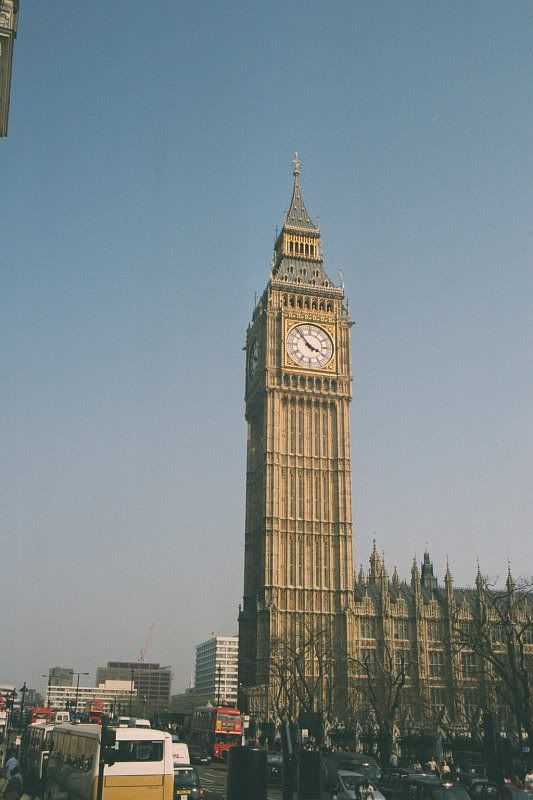
Or more sights that look like this?

Either way it looks like a win-win situation for yours truly.
Cheerio!
So will I see more sights like this?
Or more sights that look like this?
Either way it looks like a win-win situation for yours truly.
Cheerio!
Friday, May 13, 2005
Unclear About The Concept
It seems some folks in England are not too keen at the thought of Tampa Bay Buccaneers owner Malcolm Glazer taking controlling interest in Manchester United. However, these fans need to do a little work when it comes to the intellectual force of their arguments, as these pictures can attest.
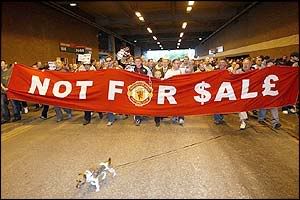

It seems to me you can say a lot of things about a publically held company on a major world stock exchange, but you cannot say it's "Not For Sale."
It seems to me you can say a lot of things about a publically held company on a major world stock exchange, but you cannot say it's "Not For Sale."
I'm Going To Be Vicious & Unfair
...you've been warned.
It's getting harder to read headlines like this from the Daily Kos:
Entire Marine squad wiped out
And not read it as if Kos and his readers view it as:
Entire Marine squad wiped out (Hooray!)
Maybe it is just me, but if I were to write about this incident on this site I think I would entitle it something like "Tragedy in Iraq" or "Heartbreak for the Marines."
Maybe making rhetorical points on your blog is more important than I realized.
It's getting harder to read headlines like this from the Daily Kos:
Entire Marine squad wiped out
And not read it as if Kos and his readers view it as:
Entire Marine squad wiped out (Hooray!)
Maybe it is just me, but if I were to write about this incident on this site I think I would entitle it something like "Tragedy in Iraq" or "Heartbreak for the Marines."
Maybe making rhetorical points on your blog is more important than I realized.
Thursday, May 12, 2005
Academia's Great New Idea: Prohibition!
They are engaged in a great moral crusade out at Berekley. Damn you Budweiser!
Growing concerns about alcohol-related incidents have led the University of California, Berkeley, to enact a ban on alcohol consumption at all events hosted by campus fraternities and sororities, officials announced today (Monday, May 9).
The ban goes into effect immediately. It applies to all fraternities and sororities and all activities hosted by the campus's Greek community.
---
The last time the campus banned alcohol in the Greek community was April 2002. That moratorium was limited to fraternities and sororities with chapter houses and to social events. A gradual lifting of that ban took place at the end of the fall 2002 semester as chapters demonstrated responsible actions at parties and other events.
UC Berkeley has 70 fraternities and sororities with more than 2,500 members. Under a current and longstanding campus policy, hard liquor is banned. Beer and wine are permitted for students of legal drinking age, but are prohibited if served from kegs or other bulk containers. In addition, all alcohol use is banned during fraternity and sorority recruitment weeks.
Obviously the laws of the state of California are not near good enough for the folks in the People's Republic. Lord knows how many other leagal activities they have deigned to ban, or will in the future.
Will there ever be a generation of people like the Baby Boomers again? I sure hope not. I'm not sure any nation could survive quite that much hypocrisy twice in it's history. They have gone from being "You don't have to live by YOUR laws, man" lefties to "Do as we say (not as we did)" oligarchs. They don't even have the simple common human decency to be abashed about the change.
I've often said that in dealing with alcohol our entire nation seems to be unable to learn from history. There have been prohibitionary schemes since colonial times and they have never succeeded in changing people behavior except for the worse. Yet such schemes keep coming back like some sort of Hydra, and often in the silliest of forms. For example, the prohibition against "hard liquor" but not beer and wine sounds exactly like the kind of thing you would expect to find in some quaint Victorian backwater circa 1880. That it exists as the law of the land in Berekeley today would be hysterical if it weren't so damn pathetic. Believe it or not it is just as possible to get blindingly drunk on Coors Light as it is drinking Cutty Sark. (Although why one would voluntarily ingest either of those beverages is beyond me...but thats a different issue.)
Now I don't have anything against Berekeley encouraging responsible behavior. The problems are A) We generally do not expect responsible behavior from younger folks so we tolerate more lower intensity bad behavior than we should, B) We overreact when something bad happens (e.g. an alcohol related death or violence) in a way that actually promotes further bad behavior by removing youth drinking from the public eye, and C) We ignore the fact our basic problems with alcohol stem from the terrible set of laws we have set up to govern the practice.
There is no ratonal explanation for setting up a system that encourages the development of 21-year-old kids who have no postive experiences with alcohol, who have no history of drinking responsibly, and who are treated as pseudo-adults even after they turn twenty-one. No wonder they keep acting like dumb children long after they should know better. Everything about our culture tells them that is normal.
Growing concerns about alcohol-related incidents have led the University of California, Berkeley, to enact a ban on alcohol consumption at all events hosted by campus fraternities and sororities, officials announced today (Monday, May 9).
The ban goes into effect immediately. It applies to all fraternities and sororities and all activities hosted by the campus's Greek community.
---
The last time the campus banned alcohol in the Greek community was April 2002. That moratorium was limited to fraternities and sororities with chapter houses and to social events. A gradual lifting of that ban took place at the end of the fall 2002 semester as chapters demonstrated responsible actions at parties and other events.
UC Berkeley has 70 fraternities and sororities with more than 2,500 members. Under a current and longstanding campus policy, hard liquor is banned. Beer and wine are permitted for students of legal drinking age, but are prohibited if served from kegs or other bulk containers. In addition, all alcohol use is banned during fraternity and sorority recruitment weeks.
Obviously the laws of the state of California are not near good enough for the folks in the People's Republic. Lord knows how many other leagal activities they have deigned to ban, or will in the future.
Will there ever be a generation of people like the Baby Boomers again? I sure hope not. I'm not sure any nation could survive quite that much hypocrisy twice in it's history. They have gone from being "You don't have to live by YOUR laws, man" lefties to "Do as we say (not as we did)" oligarchs. They don't even have the simple common human decency to be abashed about the change.
I've often said that in dealing with alcohol our entire nation seems to be unable to learn from history. There have been prohibitionary schemes since colonial times and they have never succeeded in changing people behavior except for the worse. Yet such schemes keep coming back like some sort of Hydra, and often in the silliest of forms. For example, the prohibition against "hard liquor" but not beer and wine sounds exactly like the kind of thing you would expect to find in some quaint Victorian backwater circa 1880. That it exists as the law of the land in Berekeley today would be hysterical if it weren't so damn pathetic. Believe it or not it is just as possible to get blindingly drunk on Coors Light as it is drinking Cutty Sark. (Although why one would voluntarily ingest either of those beverages is beyond me...but thats a different issue.)
Now I don't have anything against Berekeley encouraging responsible behavior. The problems are A) We generally do not expect responsible behavior from younger folks so we tolerate more lower intensity bad behavior than we should, B) We overreact when something bad happens (e.g. an alcohol related death or violence) in a way that actually promotes further bad behavior by removing youth drinking from the public eye, and C) We ignore the fact our basic problems with alcohol stem from the terrible set of laws we have set up to govern the practice.
There is no ratonal explanation for setting up a system that encourages the development of 21-year-old kids who have no postive experiences with alcohol, who have no history of drinking responsibly, and who are treated as pseudo-adults even after they turn twenty-one. No wonder they keep acting like dumb children long after they should know better. Everything about our culture tells them that is normal.
Subscribe to:
Posts (Atom)